
Ancient Woodlands and the new England Trees Action Plan
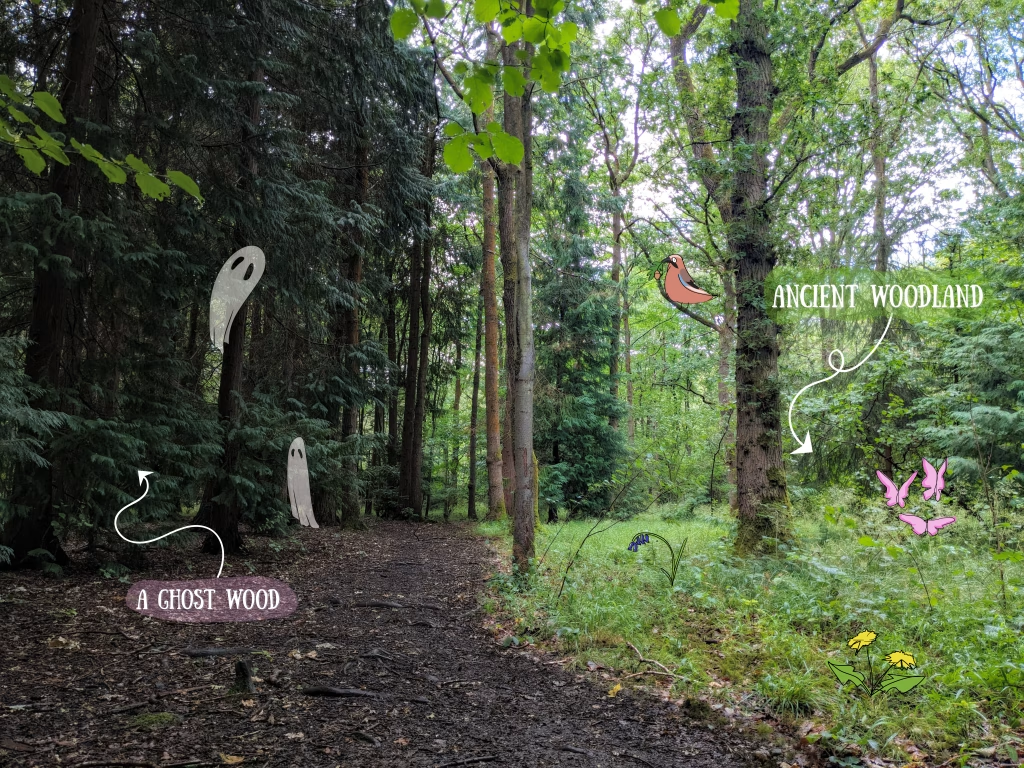
At the end of last month Wild Card’s Ghost Woods team contributed to DEFRA’s consultation on the upcoming England Trees Action Plan.
The England Trees Action Plan is where the Government sets out how they are going to support woodland conservation and creation for the rest of their term – including how they plan to spend £1 billion which has been announced as set aside for tree planting. The previous England Trees Action Plan expired in 2024 and funding pots like the Nature for Climate Fund that has funded much of the woodland creation and restoration efforts similarly expired this year. The previous plan was strong in some areas, but left much to be desired in terms of ancient woodland restoration, including in the temperate rainforest zone. We hope that the forthcoming England Trees Action Plan will rectify these oversights.
Unlike the previous Plan, the new England Trees Action Plan will not have a public consultation which makes it even more important that we are transparent about how we are representing the 130,000 concerned members of the public that are supporting our campaign.
Taking the lead from Guy Shrubsole who posted his submission here, we’re publishing below what we submitted to DEFRA.
However, before we dive into the specifics, here’s a brief summary of our asks for those who don’t want to slog through the whole 8 pages.
What Wild Card wants to see included in the new England Trees Action Plan:
- A commitment to proper and ongoing funding of the restoration of Plantations on Ancient Woodlands (PAWS) on the Public Forest Estate.
- A plan that addresses and contributes toward meeting the Government’s various national statutory targets, international commitments and policy declarations, not just the woodland creation target.
- A holistic approach that includes various strategies, including the maintenance and restoration of existing woodlands, natural woodland regeneration and spatially targeted tree planting.
- A clear target for the restoration of PAWS by Forestry England and an outline of what will be done to ensure government commitments are met across the board, by both public and private bodies.
- A requirement set for Forestry England to publish its accounts and progress regarding PAWS restoration work for public access.
- Greater encouragement for natural tree regeneration through amendments to the funding guidelines.
Consultation on the forthcoming Trees Action Plan for England
Submission from Wild Card, November 2025
Wild Card is a grassroots organisation campaigning for progress on the nation’s PAWS restoration commitments. To date, our campaign has received the support of over 128,000 members of the public, including prominent figures such as Dame Judi Dench. We welcome the opportunity to advocate for the public’s desire to see our ancient woodlands restored and brought back to life.
Below is our feedback on DEFRA’s proposal core themes for the forthcoming England Trees Action Plan:
Alignment with biodiversity targets
It is crucial that the next England Trees Action Plan (the Plan) contributes to meeting the Government’s multiple commitments on biodiversity, tree cover, and habitat health, with a central focus on the maintenance and creation of woodlands and treescapes to maximise biodiversity benefits in line with the Government’s targets.
The maintenance and restoration of existing woodlands, especially Plantations on Ancient Woodlands (PAWS), must be given sufficient support and attention, alongside other schemes like natural woodland regeneration and spatially targeted tree planting, to aid the Government in meeting its crucial biodiversity targets.
The Plan must go beyond addressing the statutory target of 16.5% tree canopy and woodland cover by 2050 and take a holistic approach in meeting the various national targets and international commitments on biodiversity, including:
- The Environment Act’s legally binding target to restore or create in excess of 500,000 hectares of a range of wildlife-rich habitats outside protected sites, compared to 2022 levels by 2042 (2042 wildlife-rich habitat restoration or creation target), and the interim target to “restore or create 140,000 hectares of a range of wildlife-rich habitats outside protected sites by 2028 (2028 interim wildlife-rich habitat restoration or creation target);
- The Government’s international commitment to protect 30% of England’s land and waters for nature by 2030 (30×30 target);
- The Environment Act’s legally binding target to halt the decline in species abundance by 2030 (2030 species abundance target);
- The Environment Act’s legally binding target to reduce the risk of species’ extinction by 2042, when compared to the risk of species’ extinction in 2022 (2042 species’ extinction risk target);
- The Government’s commitment in its updated Keepers of Time policy (2022) to restore or gradually restore the majority of plantations on ancient woodland sites to native woodland by 2030 (2030 PAWS restoration target), which was reiterated in the 2023 Environmental Improvement Plan (EIP 2023).
These biodiversity targets have a far shorter timeframe than the 2050 trees target and must therefore be treated as a priority in the forthcoming England Trees Action Plan. It is unrealistic, and in some cases impossible, for tree planting alone to deliver on these targets. Therefore, the Plan must also encompass a variety of other strategies, including restoration of existing woodlands and natural woodland regeneration, to address the current severe under-deliverance on the 30×30 international commitment, legally-binding 2030 species abundance target, and the 2030 PAWS restoration target.
Prioritise PAWS restoration
A well funded and resourced PAWS restoration program in particular would contribute toward meeting a number of these targets simultaneously, thus most efficiently spending tax-payer’s money. It is our strong recommendation, therefore, that the next Trees Action Plan incorporate:
1. Prioritising “grants / funds to support woodland creation and trees outside woodlands” for PAWS Restoration on the Public Forest Estate
One of the most effective ways to ‘spatially target biodiversity’ is the restoration of England’s Plantations on Ancient Woodland (PAWS). PAWS account for 38.5% of all ancient woodland in England, covering over 135,000ha. These sites are widely recognised as representing our only chance of extending the cover of Ancient Semi-Natural Woodland (ASNW) beyond the pitiful 1.6% of England that it currently clings on to. As the Government recognises, ASNW is the most biodiverse habitat on land. Despite being a priority habitat, and several Government commitments, very little progress has been made on PAWS restoration.
Over 32%, 42,781ha, of all English PAWS are within the Public Forest Estate, and yet no funding towards restoration has been publicly-announced. The England Trees Action Plan must publicly commit to ongoing, and sufficient, funding for PAWS restoration on the Public Forest Estate. Funding of PAWS restoration on privately-owned land, Countryside Stewardship option WS2, must also be increased to accurately reflect the actual cost of restoration work.
Concerted efforts to fund and expedite the restoration of PAWS on the Public Forest Estate would deliver significant progress on several Government targets:
a) 2030 species abundance and 2042 species’ extinction risk targets
Current progress towards these targets show a concerning lack of movement. DEFRA’s Indicators of Species Abundance for England does not show signs of recovery, instead it shows a deterioration in the long-term (1970-2023) and little to no change in the short-term (2018-2023). The trend for woodlands specifically is even more concerning. The Woodland Trust’s ‘State of Woods and Trees’ report this year revealed that despite increased tree planting, woodland biodiversity continues to decline with the woodland bird index decreasing by 15% in the last five years. PAWS restoration offers significant opportunities to change these trends.
- ASNW are home to more endangered species than any other habitat, with 66 of the 69 Ancient Woodland Indicator flora appearing on the UK Red Listed Species. These include some of England’s most charismatic species like bluebells and lily-of-the-valley.
- Due to the remnants of ASNW remaining, the restoration of PAWS offers the best chance of returning to characteristic assemblages of ANSW.
- PAWS restoration on the Public Forest Estate would also support the restoration of Britain’s globally-rare temperate rainforest habitat. Restoring publicly-owned PAWS within the rainforest zone would result in over 2,000ha of temperate rainforest, an incredibly species-rich ecosystem which would contribute significantly to both the species abundance and habitat restoration targets.
- With five years left to meet the legally-binding species abundance target, current efforts appear to be severely off-track. The England Trees Action Plan must prioritise funding the restoration of PAWS to most effectively target increasing species abundance, biodiversity, and reducing the risk of woodland species’ extinction.
b) 2042 and 2028 interim wildlife-rich habitat restoration or creation targets
- As of March 2025, only 38,877ha are eligible to contribute to the habitat restoration or creation target. This leaves the Government four years to add an additional 101,123ha if they are to meet the interim EIP23 140,00ha target (although the upcoming EIP25 may update this target).
- PAWS restoration is the only type of woodland habitat restoration that can count towards meeting the habitat restoration and creation target making it imperative that the forthcoming England Trees Action Plan acknowledges the importance of funding PAWS restoration.
- PAWS on the Public Forest Estate alone could contribute over 26,000ha to the target. Currently, PAWS managed by Forestry England only contribute 767ha towards the target due to slow progress – exasperated by a lack of funding. To avoid the political embarrassment of a public body lagging behind the private sector when it should be leading the way, the England Trees Action Plan must encourage, through funding and transparent guidelines, an intensification of restoration work.
c) 30×30 target
- DEFRA’s own statistics show that as little as 7.1% of land in England currently contributes to the international 30×30 commitment.
- Within the National Estate for Nature Group, which brings together private, third sector and public bodies to “support the delivery of the terrestrial Environment Act targets and related nature recovery objectives such as 30by30, through action on members’ own estates”, it is essential that public bodies like Forestry England set the example for delivering on the Government’s targets. PAWS restoration has the potential to deliver on multiple targets, and on the Public Forest Estate would increase the current contribution to 30×30 by 42,781ha.
d) The Labour Government’s commitment to “Expand nature-rich habitats (…) including on public land.”
- In its election manifesto the Government specifically committed to expanding nature-rich habitats on public land. As detailed above, the current Government progress is lagging behind its commitments on biodiversity and habitat restoration and creation.
- Funding PAWS restoration on the Public Forest Estate would be an essential step forward in meeting this manifesto commitment and must form a key part of the England Trees Action Plan. Doing so would contribute to the Government targets mentioned above, which it risks missing, and would bring funding for public land in line with that available to private landowners under Higher-Countryside Stewardship WS2 option.
2. Clear guidance on how the Keepers of Time target will be met
The Government’s Keepers of Time (2022) policy acknowledges the “value of ancient and native woodlands and ancient and veteran trees in England” and updates the original 2005 target to “restore or gradually restore the majority of plantations on ancient woodland sites to native woodland by 2030”. Despite the updated target giving the Government an additional decade after the first 2020 target was missed, the Government remains significantly off-track to meet the 2030 target. This is the most significant target for PAWS restoration in England, and yet little progress has been made in the 20 years since the publication of the first Keepers of Time.
PAWS restoration rates on private land have dropped off a cliff-edge since the Keepers of Time policy was updated in 2022. According to the latest Forestry Commission indicator statistics, there has been no measurable restoration work on privately-owned PAWS in 2024-25, and as little as 6ha and 1ha in the two years prior. This is a massive decrease in restoration rates compared to the average of 100 hectares per year restored in the five years prior to 2022. This is a shocking failure in Government policy and must be rectified with clear guidelines and increased funding in the forthcoming England Trees Action Plan.
PAWS restoration on the Public Forest Estate isn’t fairing much better. According to Forestry England’s Natural Capital Accounts they have only improved the Semi-Natural Score of 3,553ha of the PAWS on the Public Forest Estate in the last reported decade. This leaves over 73% of PAWS under Forestry England management still in urgent need of intensive restoration work. Our analysis, published in The Guardian, shows that at the current rate of progress Forestry England will be more than 80 years late on delivering the Government’s Keepers of Time commitment. Forestry England have their own internal target, which has only recently been made publicly available, to increase the Semi-Natural Score of all their PAWS by 2044. This too they are more than 60 years behind on.
The forthcoming England Trees Action should provide a clear target for Forestry England to work towards and outline what will be done to ensure Government commitments are met across the board, by both public and private bodies.
3. ‘Engaging the public’ – Measuring progress, transparency and accountability
The urgent need for greater funding for PAWS restoration on the Public Forest Estate must be accompanied with a requirement for increased clarity in the England Trees Action Plan on how Forestry England’s progress will be measured and accountable to the public.
We welcome the recent additions on Forestry England’s website detailing their PAWS restoration efforts, but more needs to be done to engage with the public, who have demonstrated their keen interest in the restoration of England’s PAWS. To inform greater numbers of the public of their precious natural heritage, signs should indicate where there are PAWS in public woodlands and what restoration work is scheduled to be undertaken to return these PAWS to their native states. Not only will this serve to educate the public, it will also allow the public to hold Forestry England to account if and when promised change fails to occur.
On a national level the England Trees Action Plan must set out how PAWS restoration on the Public Forest Estate will be tracked. There is currently no accurate way to track PAWS restoration undertaken by Forestry England, which should be of huge concern given that PAWS restoration is so crucial for meeting Government biodiversity targets. The guidance for the EA Habitat Target uses movement between semi-natural scores (measured in the Natural Capital Accounts) as a qualifying requirement for contributing to the target. However, the Natural Capital Accounts don’t show work undertaken, merely movement between semi-natural scores. Therefore, a lack of movement between years implies a lack of concerted work, when in reality it tracks a lack of movement between semi-natural scores. The Forestry Commission Indicator Statistics show the amount of hectares worked on in each reporting period, but it is impossible to determine if the same areas are appearing across multiple years. This makes it impossible to track the progress Forestry England are making in meeting the Government’s Keepers of Time 2030 commitment.
Concerningly, according to responses to requests for information under the Environment Information Regulations, Forestry England keep no record of how much PAWS restoration has cost them in the last five years, nor how much it is likely to cost them in the next five years. This is a significant issue for public accountability as they are the public body entrusted with the management of the Public Forest Estate. The England Trees Action Plan must set a requirement for Forestry England to publish its accounts relating to PAWS restoration work for public access, and clearly establish how restoration progress will be tracked.
Encourage greater levels of natural regeneration
PAWS restoration is crucial for meeting the Government’s biodiversity and habitat restoration targets, and must be situated alongside efforts that ensure the tree canopy and woodland cover target is also met. Therefore, the forthcoming England Trees Action Plan should include a commitment to increased nationwide funding for natural regeneration, without spatial restrictions. Natural regeneration alongside spatially targeted tree planting efforts should support the Government to meet both its woodland creation and biodiversity targets simultaneously.
Natural regeneration (or natural colonisation) of woodland, scrub and scattered trees delivers substantial biodiversity gains relative to planting. Scrub, the ‘advance guard’ of shrubs and scattered trees, forms an important transitional habitat, supporting species such as Red-Listed nightingales in South-East England and Red-Listed cuckoos across the UK.
Natural regeneration promotes more diverse age structures, enhanced structural complexity (including ecotones and edge habitats) and higher species diversity than plantation schemes.
Although the English Woodland Creation Offer (EWCO) has included a natural regeneration grant since 2021, Forestry Commission data show that 95% of EWCO funding has been directed to planting and only 5% to natural regeneration.
The Plan should extend EWCO’s natural regeneration eligibility from 75m to 150m from a seed source and increase the duration of the grant from 10 to 20 years.
The Plan should also require amendments to the Woodland Carbon Code (WCC), which currently disadvantages natural regeneration through a minimum stocking requirement of 400 stems per hectare by year 5, a metric suited to low biodiversity plantation systems. The WCC should instead align with the EWCO threshold of 100 stems per hectare by year 10 to support natural regeneration and greater levels of biodiversity.
Conclusion
In summary, our key recommendations for consideration in the forthcoming England Trees Action Plan are:
- Address and contribute toward meeting the Government’s various national statutory targets, international commitments and policy declarations
- Adopt a holistic approach that includes various strategies, including the maintenance and restoration of existing woodlands, natural woodland regeneration and spatially targeted tree planting.
- Commit ongoing funding towards and expedite the restoration of PAWS on the Public Forest Estate.
- Provide a clear target for the restoration of PAWS by Forestry England and outline what will be done to ensure Government commitments are met across the board, by both public and private bodies.
- Set a requirement for Forestry England to publish its accounts and progress regarding PAWS restoration work for public access.
- Encourage natural regeneration through amendments to the EWCO and WCC.
Our blog posts are written by our core team and guest bloggers. If you have an idea for a blog post please pitch it to us: info@wildcard.land
CAMPAIGNS
ARCHIVES
- October 2026
- September 2026
- August 2026
- July 2026
- June 2026
- May 2026
- April 2026
- March 2026
- February 2026
- December 2025
- November 2025
- October 2025
- September 2025
- August 2025
- July 2025
- June 2025
- May 2025
- April 2025
- March 2025
- February 2025
- December 2024
- November 2024
- October 2024
- September 2024
- August 2024
- July 2024
- June 2024
- March 2024
- February 2024
- January 2024
- December 2023
- November 2023
- August 2023
- July 2023
- May 2023
- February 2023
- January 2023