
Rewilding Species Of The Month: Sphagnum Moss
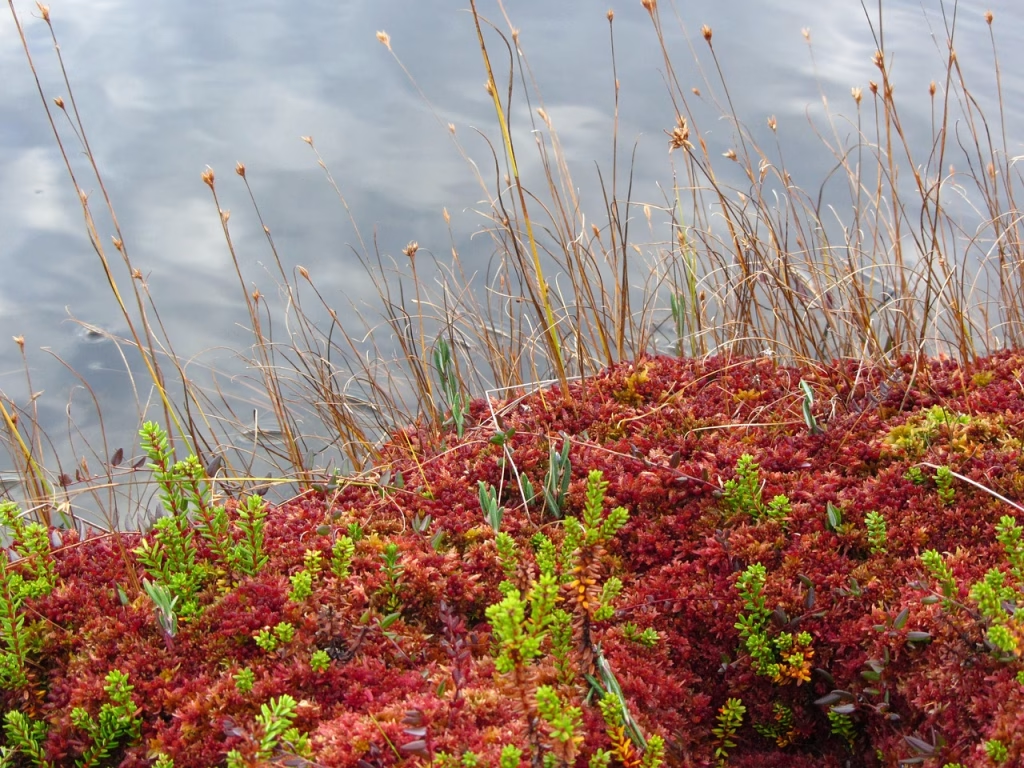
Being hailed across the internet as a ‘Miracle Moss’, ‘Nature’s Superpower’ and even ‘The Most Important Plant on Earth’ it’s about time that sphagnum enjoyed its place in the spotlight as our Rewilding Species of the Month. Although it is not strictly speaking a species but a genus (a family of closely related species), I’m sure that sphagnum fans will forgive me this oversight when my purpose is merely to draw more attention to how ‘awesome’ this little bryophyte is. Learning to love sphagnum brings a great deal of joy, but it also brings frustration too. Though sphagnum’s seemingly hyperbolic descriptions are well-deserved, there is an unbearable lack of awareness of this amongst the general population. In a world full of pain and suffering it would be fantastic if more people knew that there’s this tiny thing that is packed full of hope – and its name is sphagnum moss.
Sphagnum is a beauty
It’s difficult to know where to start in honouring sphagnum so perhaps it makes sense to start with the most superficial reason to love it. Sphagnum moss is beautiful. Covering a spectrum of colour, with rich red wines, chocolate browns, sparkling copper, and delicate pink, looking at a blanket of sphagnum can be like gazing out onto an autumn woodland at sunset (though in miniature). Elsewhere it is a kaleidoscope of greens, fading to apple blossom white. If you are lucky and the algorithms catch you right, you may one day find yourself in the social media niche where moss fans share their sphagnum pin ups. Believe me, I have been there, and it certainly beats whatever Grok puts out.
Back in the real world, looking more closely at sphagnum can save you a welly full of water. By understanding this moss more and recognising its colours, shapes, and forms, you not only learn to respect the moss but can also read the different things it is telling you. A pretty useful trick is being able to tell if the area before you is solid ground. Some species of sphagnum form a magic carpet of green floating on the surface of bog water whilst others act as a beautiful cloak laid over heavily saturated decomposing matter only to sink down when stepped upon. This is a lesson that I wish I had known when, as an uninitiated teenager, I went racing across a blanket bog in Ilkley to see if the cotton grass was as soft as it looked.
Defender of Our Homes
Understanding sphagnum can save us from submersion in another way too. One of its superpowers is that it can absorb up to 20 times its dry weight in water, holding water both within its own cellular structure and between the different plants. This can be incredibly significant for towns and villages that are at risk from surface and fluvial flooding. Whilst damaged peatland moors will drain very quickly, a healthy sphagnum rich moorland is rougher and undulates around hummocks, holding back water and slowing the flow. One way of explaining this, used by the National Trust, is to speak of sphagnum moss as “speed bumps” for rainwater. Meanwhile, intact riparian zones, where sphagnum mosses thrive on the banks of the rivers and water channels, reduce peak flow even further.
As we look towards a future with more extreme weather events, sphagnum moss can make a real difference in protecting the homes and businesses of people on flood plains, and safeguarding them from the stress that heavy rainfall brings. Conversely, the ability of sphagnum to hold water and to slowly release it mitigates against periods of drought. Not only this, but flood water from peatlands missing some of their moss carries the peat down with it increasing the acidity of the water. This both affects life within the river and hits water companies with high purification costs. It is therefore vital that we rewild our peatlands and enable sphagnum recovery to heal our moors and fens.
Be A Hero to Our Hero Moss
Sphagnum species can be sensitive souls. Some were affected by agricultural intensification and climatic change in the Middle Ages; many more were choked in the toxicity of sulphur dioxide during the Industrial Revolution; and still others were lost to the nitrogen oxide of vehicle emissions. With such unintentional losses leaving behind so much degraded peatland, it is even more tragic that the mosses then fell prey to intentional burning, draining and extraction. Sometimes devastation has grown from the desire to grow a pretty garden; sometimes it has been to intensively farm grouse for shooting. Humanity has a lot to answer for. That said, humanity also has the potential to be heroic.
Experts such as Moors for the Future and the Wildlife Trusts are teaming up with volunteers, such as folk from the British Mountaineering Council, to restore our precious landscapes and bring back the sphagnum rich ecosystems that have been lost. In greenhouses across the land, from large scale projects to individuals in small back gardens, there are heroes dedicated to nursing sphagnum. The intention is that the plants they have nurtured will be plugged back into place on our degraded peatlands. People do this in part to prevent flooding, but sphagnum is more than just a defence against floods. Although each little sphagnum moss is tiny, it does more than any other plant to tackle the biggest issue facing the world today: climate change.
Saviour of the Planet
As a plant without roots, sphagnum takes all its water and nutrients from the surface and from rainfall. Water retention is therefore essential to its survival during drier times, and it’s cleverly adapted to influence the environment around it. By taking in positive ions and releasing hydrogen, sphagnum creates an acidic environment in which it practically pickles dead matter. This causes a layering up of vegetation below the surface to create contours and hummocks between which water pools. A side-effect of these conditions is that sphagnum moss acts as our mini climate hero. Carbon taken in by the upper layers of moss through photosynthesis is trapped and compressed to form peat. Forget futuristic and expensive carbon capture technologies: sphagnum has you covered! Even though it only covers 3-4% of the world’s surface, the peat bogs created by sphagnum contain 33% of the world’s soil carbon.
Sadly, here in the UK, 80% of our peatlands are damaged. This means that, rather than sequestering carbon from the atmosphere, the bare peat where sphagnum should be oxidises to become a carbon emitter instead. Peatland restoration through actions such as sphagnum planting should therefore be a key priority for anyone concerned about protecting the planet. To put things into perspective, the Wildlife Trusts report that “If we were to lose a further 5% of the peatland in the UK, this would equate to all of the annual man-made carbon dioxide emissions in the UK.” Whilst we quite rightly fight to save our rainforests, peatlands store twice as much carbon. It’s therefore vital that we fight to save our sphagnum too.
The need to act is also urgent. The UK Government’s Climate Change Risk Assessment has listed wildfires as a key threat resulting from climate change. Upland wildfires threaten the public’s health through pollution, cause damage to the rural economy, damage biodiversity and put firefighters lives at risk. They also create a significant climate feedback loop. The higher levels of carbon in our atmosphere lead to higher temperatures and drought. In damaged landscapes, where peat is exposed and vegetation is much drier than on rewetted moss-rich bogs, the chance of fires becoming uncontrollable is much higher. These wildfires then release more carbon into the atmosphere as the peat burns and the peat left behind oxidises. In contrast, in a rewetted moor, with healthy sphagnum, the spread of wildfire is greatly reduced.
A word of caution to all keen sphagnum carpet fitters however. There are over 30 different species of sphagnum moss in the UK and, whilst some species will grow more easily than others, we must also be sensitive to the ecology of our moorlands. Though one or two species will be a quicker fix to show returns on our sphagnum investment, it must not be at the expense of other sphagnum species. Consulting a bryologist before any venture is therefore highly recommended. Sphagnum is not to be viewed simply as an ecosystem service for humans. Like all of nature, it has value in itself and each sphagnum species -even the tiddly ones that are slow to spread – is worthy of our respect.
Protector of Bog Bodies.
But sphagnum does more than enact its magic on the moors, it absorbs carbon across other parts of the UK too. Species of sphagnum thrive in the rich fens of East Anglia, the Celtic rainforests of Scotland, Wales and Ireland, and the aptly named lowland ‘mosses’ of the North West. It is in such places that you might come across bog bodies.
At the mention of bog bodies, your mind may turn to individual bodies such as Pete Marsh, the preserved Iron Age man found pickled in Lindow Moss near Manchester. However, the bodies unearthed in archaeological digs aren’t the only bog bodies that deserve our attention. Wherever you find sphagnum, you will find a whole host of other life there too. Some, such as the curlew, flies above the moss and some are only observable through a microscope. Each healthy sphagnum plant hosts its own little community of creatures, and its branches are hunting grounds for rotifiers and tardigrades (also known as water bears). One scientist found 32,000 species from a sphagnum moss growing in a bog.
As well as providing a banquet of microscopic species, the structural variety of sphagnum rich landscapes also creates ecological niches for a diverse range of life. Birds might make their nest upon the drier hummocks and feed on the invertebrates skating over the pools; dragonflies feast on midges; and a range of plant species, from sundews to cranberries, can find a favourite spot nestled within the moss.
If I had to choose then my number one bog body discovered in all my adventures in sphagnum research is Huldra. Huldra is a beautiful figure from creatives in Norway who brought her out of her peaty grave. She sings to us about our exploitation of peatlands in this brilliant music video featuring gorgeous illustrations of sphagnum mosses. If you don’t speak Norwegian than it’s best to play this with English subtitles on but a key lyric is ‘If you dig in my grave, you’re digging your own grave.”
Healer of People
But let us not finish on a grave note and instead turn to moss as a teacher and a healer. For too many years humans have been at war with nature, destroying it and exploiting it rather than working with it and within it. In her incredible book Gathering Moss Robin Wall Kimmerer urges us to come to know, respect and learn from mosses.
The healing nature of sphagnum moss does not just rest in its grandiose ability to heal the entire world through carbon capture. Sphagnum is also able to offer healing in smaller individual ways too. In order to protect the cell walls which hold its water, sphagnum evolved with antiseptic properties this, together with its absorbency, meant that it was able to help soldiers suffering in war time. Even as recently as the World Wars, when antiseptic was hard to come by, sphagnum was sent to battlefields as bandages for healing. There are wonderful stories of girl guides, boy scouts and holiday makers heading up to where sphagnum was plentiful and gathering the moss to send to the front lines. In my favourite account, an Edinburgh scout master led his boys up to face the midges accompanied by pipes and drums.
So, following on from Robin Wall Kimmerer’s message, what can we learn from sphagnum moss about healing? Perhaps it is that, whilst sometimes we can take large actions for the world, we can also work in small ways too to protect and restore life. Each little sphagnum moss can do significant things, either individually or working together at scale. So too can we. We can absorb a person’s pain and offer healing words. We can gather in our communities to protect our neighbours when they are vulnerable and blanket them from harm.
And we can work for nature too, not least for our little friend the moss. Now you have been initiated into viewing sphagnum as a ‘miracle moss,’ you might volunteer to help in the sphagnum revival movement. Perhaps you will create music and artwork to let people know how awesome sphagnum is, or simply write a letter, a social media post, or a blog. Sphagnum moss offers to heal the world’s wounds, and now it’s time for us to return the favour.
Our blog posts are written by our core team and guest bloggers. If you have an idea for a blog post please pitch it to us: info@wildcard.land
CAMPAIGNS
ARCHIVES
- October 2026
- September 2026
- August 2026
- July 2026
- June 2026
- May 2026
- April 2026
- March 2026
- February 2026
- December 2025
- November 2025
- October 2025
- September 2025
- August 2025
- July 2025
- June 2025
- May 2025
- April 2025
- March 2025
- February 2025
- December 2024
- November 2024
- October 2024
- September 2024
- August 2024
- July 2024
- June 2024
- March 2024
- February 2024
- January 2024
- December 2023
- November 2023
- August 2023
- July 2023
- May 2023
- February 2023
- January 2023