
Rewilding Species of the Month: Common Ivy
Ivy is a controversial plant that gets a whole lot of people reaching for the secateurs to butcher the green monster. In the UK, where Common Ivy is a native and therefore non-invasive species, this attitude can be symbolic of humanity’s need for control over nature or it may be symbolic of our misunderstanding of the interplay of ecosystems. Which one of the two depends upon what the motivation is to cut the ivy down. However, in exploring Ivy (Hedera helix) as our rewilding species of the month my aim is that this wonderful and important evergreen grows on you and that your relationship with it shifts. More importantly, I hope that the next time you see ivy covering a home or climbing to the top of a tree you are filled with joy and wonder rather than animosity.
For myself, I have never viewed ivy as a monstrous foe. I never got to grips with gardening so didn’t need to worry about ivy invading my flower beds. I never lived in the kind of house where you might worry about ivy creeping over your window and plunging your room into darkness. Instead, ivy was something I never really thought about. It may have acted as a background green screen to my childhood adventures in nature but even if it were present, I never really noticed it.
A hidden life
The first time I did notice ivy was in my teenage years and it was a moment of awe. I was sitting with friends on some grass by the side of an old building when something happened (I can’t remember what – a sudden noise maybe?) and a whole host of birds appeared from nowhere and lifted off into the air. They were roosting in the ivy which covered the building’s wall. At that moment I realised how unaware I had been of my surroundings and the hidden life all around me. It had such a profound effect on the way I view the world that it has stayed with me all these years later.
The shelter that ivy provides via its dense foliage is not just an attraction to birds either. It also provides protection from the elements to small mammals, like bats and mice, and to a huge variety of invertebrates, including ladybirds, butterflies and spiders. In fact, our often unappreciated ivy is considered by many experts to be a keystone species in our native ecosystems, particularly if it is left to mature. By cutting it back before it has chance to reach its natural potential, we are removing something vital to so many other creatures.
A Shape Shifting Food Source.
Juvenile and mature growth ivy are so different that, until 1750, they were thought to be two completely different plants. For most people, if you were asked to draw an ivy leaf, then you would most likely draw the juvenile form. This is the lobed leaf associated with ivy crowns and the holly and the ivy of Christmas imagery. The juvenile plant is an explorer: with supple stems it can trail over the shade of the forest floor until it finds something to climb. Whether it be a tree, a house, or an old stone wall it is not fussy. It will then use this as a support to climb towards the light where it will be transformed.
It can be well over a decade before the transformation of ivy into its mature form. Its flexible stems become woody and self-supporting, and its leaves become more oval shaped. More importantly for nature, it is during this stage that ivy begins to flower. When Spring blossoms have long since flown away and Summer flowers have all wilted, ivy begins to bloom. From September to November, its flowers fill a gap left by others, providing pollen and nectar to those who still need it. A 2013 study by the Royal Entomological Society concluded that ivy has ‘high value in the conservation of flower-visiting insects in autumn’. This includes solitary bees such as the beloved Bumble and the aptly named Ivy Bee. Honey bees also value its sugar-rich nectar to stock up their hives. Leave your ivy to flower and you’ll find that your garden will soon be buzzing
Even before the ivy flowers begin to open, our insects are already making use of the plant. The Holly Blue Butterfly (Celastrina argiolus) uses it as a place to lay its second brood of eggs, with ivy leaves providing nourishment for the emerging caterpillars. Other caterpillar connoisseurs include those of the Angle Shades Moth (Phlogophora meticulous) and the spectacular Swallow Tailed Moth (Ourapteryx sambucaria)
With so many insect species relying on ivy as a food source, including rare ones like the Golden Hoverfly (Callicera spinolae), we need to look more closely at our attitude towards ivy. This is especially the case given the worrying trend in insect decline which some have gone so far as to call an Insectageddon.
A Berry Important Plant
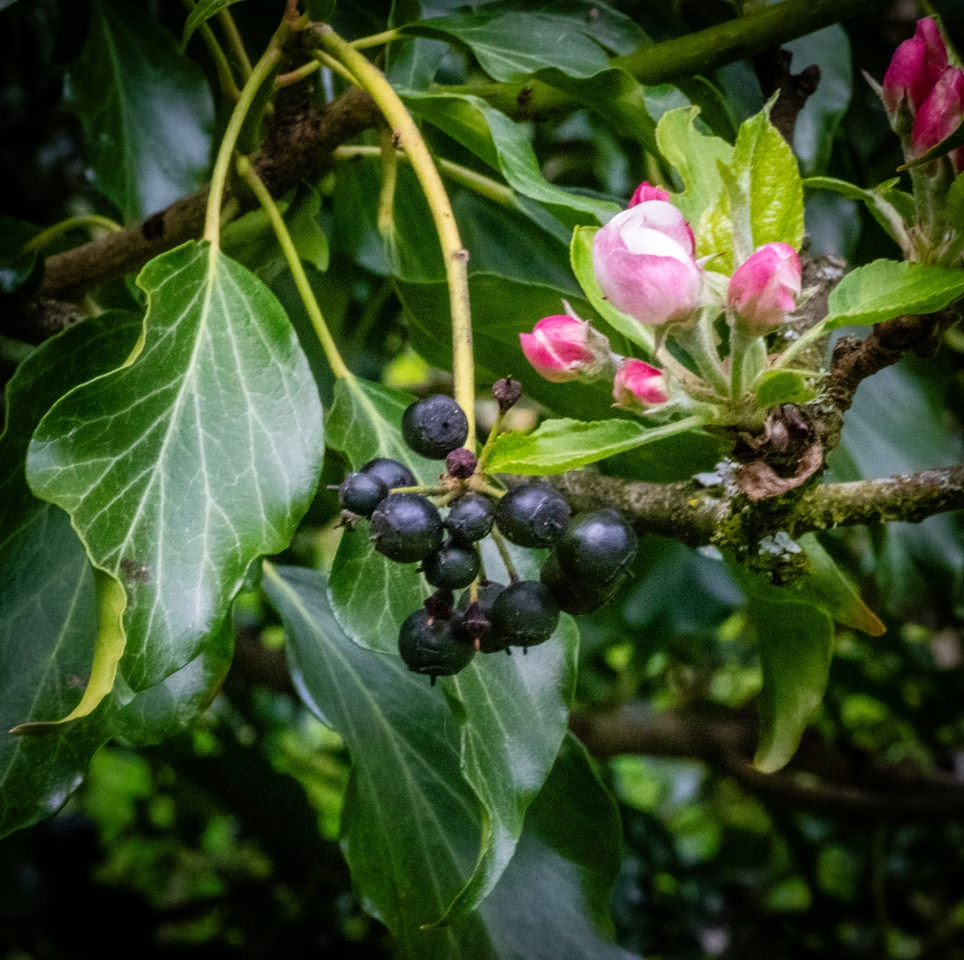
As the flowers disappear at the end of Autumn, the fruits of the ivy begin to emerge in tight spherical clusters which ripen into black berries. Throughout the harshest months of the year, they are a nutritious resource for overwintering birds. Now, as the blossom brings colour to my apple tree, the ivy which engulfs it still hangs onto the last few high energy berries. The blackbirds which have been sustained by them sing to me as I hang out my washing. I like to think they are thanking me for leaving the ivy be, though I know that really, I should not be expecting any thanks for simply allowing nature to flourish.
Admittedly, not everyone would like to totally rewild their garden. Some may wish to clip back the ivy to ensure that there are also areas full of colourful Spring and Summer flowers. In this, they play the proxy role of native herbivores such as roe deer who would have naturally kept the ivy in check. Others rely on their gardens as a source of food and to do that will need to keep the ivy from taking over raised beds and sneaking into their greenhouse. However, I would encourage everyone who is lucky enough to have a garden to allow an area within it for ivy to reach maturity. In so doing, your garden will provide a vital food source and year-round shelter for the more than human life that shares our Earth. In turn, you will be aided by more insects to pollinate your plants as well as wasps and birds to control the number of so-called ‘pests’ who might eat your lettuces before you have the chance.
An ancient woodland species
We should also be looking to restore and protect the wild spaces outside our own gardens. Ivy is a woodland species and research has shown that it prefers diverse forests with a mix of trees of differing ages, including veteran trees. Knowing the benefits of ivy to wildlife, this is yet another argument to restore our ancient woodlands smothered under timber plantations (see our Rewild the Ghost Woods campaign). Take a wander in an ancient wood and you should find it everywhere, painting the dull winter in its greenery, fuelling the dawn chorus, and sheltering so many species at all times of year. It therefore seems absurd that some woodland and forestry managers still feel the need to hack away at it. The sad thing is that people believe that this is the right thing to do.
A lover not a fighter
When you see a big old tree trunk woven around with thick ivy stems, and with a canopy thick with the plant, it can be easy to believe the myth that they are in competition. But nature doesn’t work in the same way as a free-market economy and what seems like a throttling can actually be a hug of solidarity. Ivy has long been accused of strangling trees but according to the Woodland Trust – who know their stuff when it comes to protecting trees – it doesn’t harm the tree at all.
Ivy is not a parasitic plant. It takes all the water and nutrients it needs at ground level and only attaches its feather-like hairs to cling to the trunk as it climbs upwards. It takes nothing from them and does not even penetrate the bark. In fact, there is evidence that ivy may actually help to protect the tree, cushioning it from the impact of violent storms. It’s probable that the belief in ivy contributing to a tree’s decline is due to the prevalence of ivy on trees which are about to die. An old, weak and damaged tree will let in more light, and hence the ivy grows more vigorously. Similarly, the ivy may hide issues in an unhealthy tree such as cavities and decay, even though they are not the cause.
Occasionally it may be necessary to cut back the ivy to inspect a tree that’s suspected to be at risk of falling. But this should only be for a good reason and if it’s located in a place that’s a risk to people or property. Otherwise, death and decay are just the natural way of things and interfering by cutting the ivy will not prevent the inevitable.
a well meaning misunderstanding
Unfortunately, however, the myth that ivy is a danger is so engrained in the public psyche that people are keen to interfere. A recent call out on a local Facebook group began with ‘Do you love trees?’ (they had my attention) but then went on to be about organising a community effort to strip back the ivy.
A question was even tabled in parliament to ask what was being done to raise awareness of the need to remove it. A question which was thankfully met with the response that “we do not promote or encourage the removal of ivy which can itself provide valuable habitat for wildlife”
A Poisoned Relationship
Our relationship with ivy has been poisoned by these myths but this was not always so. Ivy has a great deal of positive connections in folklore. The Greeks would wear a wreath upon their heads to avoid hangovers after heartily paying their respects to Dionysus. Meanwhile, for the Victorians, it was seen as a symbol of love and fidelity. The origin of this was no doubt the Arthurian legend of Tristan and Isolde who could not be separated even in death since an ivy vine connecting their grave could never be permanently destroyed.
Other legends in the British Isles have connected ivy with the fae. It was said to cover gateways to the faery world and be used as pathways for the faeries to travel along. Woe betide anyone who damages the faery equivalent of the M1! Similarly, allowing ivy to grow on your house would offer the occupants protection whilst purposefully destroying it would mean disaster.
A protector of the home
This last point is an interesting one since the attitude to letting ivy grow on trees has been replicated in modern day attitudes to allowing ivy to grow up your walls. Given the number of old buildings blessed with an abundance of ivy, this is something that Historic England has already looked into. Happily, research carried out by Oxford University in 2017 concluded that ivy does not root into the masonary (as so often believed). In fact ivy will only seek to root into a building if it’s own roots have been cut at the bottom (a practice once in common use as what was seen as an easy way to destroy it).
As with trees, ivy tends to only cause issues if there are already issues there. Proper maintenance and inspection may be advised to identify any problems that ivy might take advantage of. However, it was also found that this beautiful evergreen covering could be of benefit to walls and buildings. Ivy was found to moderate extremes in temperatures and wetting and drying cycles. It was also found to filter pollutants and salts, therefore guarding the stonework from decay. It seems that the folklore may have hit the nail on the head when they identified ivy as a plant which offers protection.
A friend in difficult times
As climate change puts us on course for more extremes in temperature, the role of ivy could be increasingly useful. By insulating our homes from the cold and the heat, ivy might be able to both save us money on our heating bills and avoid the need to install air conditioning.
Meanwhile, local councils have been protecting children from car pollution by installing living green screens made of ivy and studies by NASA have found that ivy is able to filter volatile organic pollutants from the atmosphere.
Whilst some may look down on the traditional practice of using ivy to relieve symptoms of whooping cough, bronchitis and asthma, ivy may have benefits in this area too. In 2021, medical research determined that ivy does indeed have properties to relieve respiratory symptoms and it has been picked up by big names in the pharmaceutical industry. (Disclaimer: given that folk knowledge of the plant has mostly been lost, please consult someone who knows what they’re doing before treating yourself with ivy leaves).
It is time to stop clinging to poisonous myths about this awesome plant. (A quick side note – Poison Ivy (Toxicodendron radicans) is a North American plant that’s not even closely related to Common Ivy). There is so much about ivy still to learn and so many ways in which it can bring fortune rather than destruction. Just as ivy seeks for a route to reach the light, let us be constantly seeking to find the truth about how our ecosystems work. In the end, it may be the best means to our protection.
Our blog posts are written by our core team and guest bloggers. If you have an idea for a blog post please pitch it to us: info@wildcard.land
CAMPAIGNS
ARCHIVES
- October 2026
- September 2026
- August 2026
- July 2026
- June 2026
- May 2026
- April 2026
- March 2026
- February 2026
- December 2025
- November 2025
- October 2025
- September 2025
- August 2025
- July 2025
- June 2025
- May 2025
- April 2025
- March 2025
- February 2025
- December 2024
- November 2024
- October 2024
- September 2024
- August 2024
- July 2024
- June 2024
- March 2024
- February 2024
- January 2024
- December 2023
- November 2023
- August 2023
- July 2023
- May 2023
- February 2023
- January 2023