
Rewilding Species of the Month: The Boar
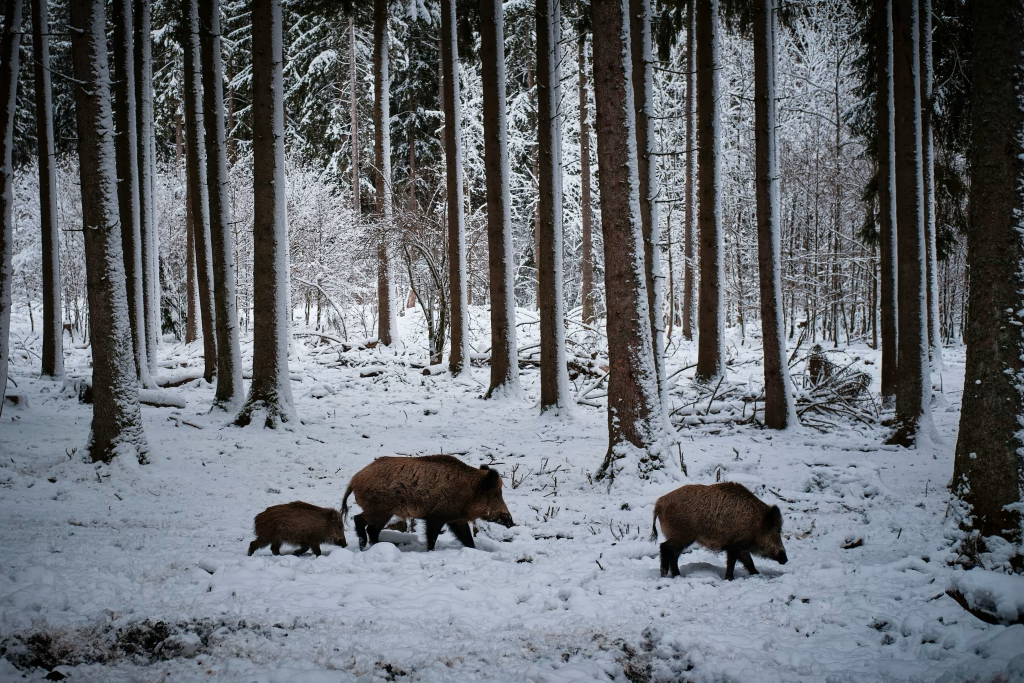
One of the earliest recorded Christmas carols in English concerns the boar, so it is the boar that I have selected to be December’s rewilding species of the month. I have not, of course, opted to tell you about the boar merely for its Christmas connection. The boar plays an incredible role in our ecosystems. Unfortunately, especially with current laws set against reintroduction, we are sorely missing this keystone species.
In fact, we are missing it so much that rewilding practitioners often need to explore other ways to make up for the loss of the boar. To take just one example, you may recently have read (in an excellent article in the Guardian) that Youngwilders pretend to be wild boar themselves, rooting the soil to restore the landscape at Maple Farm. This is not just a Youngwilders’ quirk either. On our visit to Moor Barton Wilding earlier this year, we also learned about the work being done there by staff and volunteers to mimic the behaviour of the boar by breaking up the bracken. Other rewilding projects have introduced proxy species. For example, at Knepp, Tamworth pigs have been rediscovering their wild selves in order to fill the gap left by our lost boars.
The lost boars
The story of how we lost wild boar from the British Isles is predictable to anyone who knows our environmental history. It’s that classic tale of habitat destruction and hunting. The evidence is that the boar were here before us, coexisting with natural predators such as wolves and bears. When humans first arrived, there was a respectful cohabitation but eventually deforestation for firewood and farming fragmented the boar’s favourite haunts. Then, by the 13th century they had been hunted to extinction, remaining in the UK only in legends and on coats of arms.
The exact date of the boars’ demise is complicated. The thrill of hunting them was too good to miss so they were reintroduced a couple of times from elsewhere in Europe. Unfortunately, our appetite for the hunt meant that they were very soon wiped out again. In the end, it was easier to live with their absence. Though our ecosystems would miss them, for us it was less of a big deal. Deer and fox could be hunted instead, and we had domestic pigs to replace the boar as a source of meat. That said, at Christmas time, wild boar continued to be imported by the wealthy and powerful to form the “pièce de resistance” of the Christmas feast.
The boars are back
It was probably the cultural standing of boar meat that led to the trend to bring the boar back to our shores. In the 1980s, as farms began to diversify, boar were imported again not for hunting but for farming. Unfortunately for the farmers, the boars’ intelligence as escapologists led to several accidental escapes. Nature also lent the boars a hand in ‘The Great Storm’ of 1987 when fences were torn down. There were also some more deliberate unlicensed releases in the years that followed. This is why we have wild boar roaming free in pockets of England and Scotland today, most notably in the Forest of Dean and the Scottish Highlands. The question is, given their origin on farms, are they really wild?
Wild Boars?
If boar roam wild then it makes sense to think of them as wild boar. If wild boar like these have a history of inhabiting Britain then it would seem to make sense to think of these wild boar as a native species. The law however is more complicated. In both England and Scotland, boar are not recognised in law as a wild native species. In fact, their legal status in this country is quite obscure. They are protected from unnecessary cruelty (as is the case for any other mammal) and their reintroduction into the wild is forbidden under The Dangerous Wild Animals Act (1976) but the control of feral wild boar in our country has no clear guidelines. This is significant because attitudes towards them vary considerably. Are they feral, invasive dangerous beasts who must be culled? Or are they a species with an important role to play in our landscapes, brought back to where they belong by happy coincidence?
Legends of the boar
A police forensic artist tasked with creating a sketch of a boar (based on different accounts of them) might be left with two possible images. One would be a large, sharp-tusked boar fiercely charging towards its victim. The second would present the boar in a peaceful pose surrounded by wildflowers and butterflies, with humbug striped boarlets dotted about the scene. This conflicting imagery presents what it at the heart of internalised ideas about the boar. For some people, the boar is to be loved and celebrated; for others, it is to be feared.
It is a philosophical conundrum that the boar can occupy both reputations at once. For this reason, I delight in the fact that boars are so closely connected to the godly Norse siblings Freyja and Freyr. The twin aspects of fertility and war, death and prosperity are perfect for these beautiful brutal beasts. Freyja rides on her boar Hildisvini and Freyr rides on the boar Gullibursti, but we must take care that we do not get carried away by a boar legend, particularly one which fails to tell the full story.
Badass Boars
To begin with, there is the aspect of the boar that is Hildisvini, or Battle Swine. Standing up to a metre tall, weighing hundreds of pounds and with sharp tusks they certainly look frightening. Add to this the fact that they can charge at speeds of over 30mph and you are left with a formidable foe. It is therefore understandable that folktales in the British Isles abound with stories of the bravery of our heroes as they face up to a monstrous boar.
Perhaps our fears have been entrenched in our cultural heritage. However, our lore shows more than just fear of the boar. It shows respect too. One aspect of boars’ behaviour experienced by hunters in those times was that, if cornered, a boar will not concede defeat: it will turn and fight to the death. For this reason, great warriors were compared to the boar and boars were emblazoned on coats of arms or armour as a symbol of bravery.
Living with the Boar
Today, those who live alongside the boar in places where they never went away understand boar in a way that is more real than folk tale. They have maintained a sense of respect more than a fear of being gored to death. They know that, whilst boar are quite elusive, where you do encounter one they will not charge unless they feel threatened or cornered.
There is another aspect of boar behaviour which sometimes leads to fear for those less familiar with them. If you come across a group of female boar (or sounder) foraging with their boarlets, then the matriarch of the group might stand her ground and stare you down. This is to give the young boar and their mothers a chance to get away. It is not because she is sizing you up for a fight. Leave her be, keep your dog very close by you and in time she will turn and disappear into the bracken.
What those who live alongside boar fear more than a gory death is the destruction that boar can cause. Though they are incredibly intelligent animals, boar cannot recognise what might be prized agricultural land. They have no sense of ownership rights. They see only the promise of a meal or a mud bath. Given that their long snouts and tusks are built to turn over soil at scale, the boar can leave a lot of chaos in its wake.
In Europe, a more persistent cultural tradition of hunting and eating wild boar has led to a pragmatic tolerance of the boar’s messy habits. In contrast, here in the UK, when a golf course or village green is uprooted it can be viewed as an affront to our established traditions. In cases where farmland is disturbed, the conflict with the newly arrived boar is, understandably, even greater. Those who advocate for boar reintroduction therefore have a fight on their hands.
Brilliant Boars
Whilst Freyja’s boar evokes a sense of battle, Freyr’s boar evokes brilliance. Gullibursti, or Golden Bristles, could work his magic to bring light to the darkest of places. From an ecological point of view, these are dark times in the UK and it is easy to make the case that we should be doing more to address our failings as a nation. Many argue that the return of the boar would do just that.
Boars can be seen as nature’s gardeners. Their rooting to find roots, grubs and buried acorns may rip open the land rather than rake it but in so doing it aerates the sterile soil and drives regeneration. Breaking up bracken, grasses and other monocultures, the boar clear a space for other plants to see the light of day, creating a diverse mix of wildflowers, shrubs and grasses that may otherwise have been left in darkness.
This is great news for pollinators. In his book Cornerstones, Benedict MacDonald speaks of the high diversity of butterflies that could be found on roadside verges in the Dordogne and the range of wildflowers in the disturbed forest meadows there. All of this, like the boar, is missing from our much neater but plainer countryside.
Other insects also benefit from the boar. The churning of the soil creates microhabitats where bees and beetles can burrow and small pools where dragonflies can drink. This happens on an even larger scale in the mud baths the boar create to wallow in and cool down in the warm weather. During times of drought a thirsty invertebrate can find an oasis in these mini wetlands. There too you may find amphibians and egrets enjoying a place to sustain them when other water sources have evaporated.
Hungry birds as well as thirsty birds profit from boarish behaviour. In fact, the robin’s habit of following gardeners around comes from the fact that the gardener plays the role of a boar, disturbing the soil and opening it up to expose seeds and invertebrates that can provide a meal.
But the boar’s role as a gardener doesn’t stop there. Its wiry bristles pick up seeds which can ride like Freyr on its back to find other fertile places the boar opens up to them, sometimes many miles away. Similarly, seeds carried in boar droppings will find a place to germinate in the disturbed soil. And, to tend to the trees, these droppings spread mycorrhizal fungal spores to enrich their roots.
In short, what may look to the untrained eye to be the trashing of nature is, in fact, a source of nourishment and encouragement to a whole range of our native species. No wonder Rewilding Britain describes boar as a ‘missing puzzle piece for many ecosystems across Britain’ and Scott Hendry, senior ranger at the Bunloit Rewilding Project, calls them ‘a natural cog in the rewilding wheel’
An Uncontrollable Boar
With all that said, it may also be worth reminding ourselves of the adage ‘you can have too much of a good thing.’ Boar may add to the fertility of our soil, but they themselves are very fertile too. Their average litter consists of between 4-6 boarlets, but they can have as many as 10! They are incredibly good mothers too: working together in each sounder to care for and protect their little ones.
Given that we removed the boars’ natural predators, as they begin to make a comeback, we risk a population explosion. This can be tricky especially in a nation where forest, farmland and housing sit very tightly next to one another. The pressure for space within the forests that comes with a growing population can push boar to the fringes where they may disturb the villagers as well as the soil.
And the issue of boar overpopulation in a space does not stop there. Research from Kings College London has found that unchecked disturbance by boar can result in lower soil organic carbon. They concluded that projects where boar were brought back into the ecosystem needed diverse communities of hoofed animals “to balance ecosystem functions like carbon storage and biodiversity.”
Controlling the boar population to a sustainable level is a balancing act which is currently falling to landowners. With pressures coming from both sides of the debate this is not a straightforward task. Whilst the Scottish and English governments still fail to recognise wild boar as a native species, their responsibility for addressing the issue is being shirked. Not only this, but the ethical issues surrounding the culling of a creature that we have already previously driven to extinction necessitates a process which is far more open to scrutiny. We need a national management strategy for the boar which is informed by the science, and which recognises the benefit of boar alongside the challenges.
The Philosophy Boar
When it comes to the boar there are several philosophical questions to explore. Some of these are ethical regarding including issues like our right to kill a native species. Some of them may be theological as we consider our role within the world. And some of them are phenomenological as we examine how our differing experiences of the boar can inform competing realities.
I will therefore leave you with one last legend of UK boar, and it is one which is fittingly connected with Christmas as well as philosophy. The story goes that an Oxford University scholar was so absorbed with trying to get his head around Greek philosophy that he failed to notice the wild boar upon his path. As the boar charged towards him, the young man thought quickly and rammed his copy of Aristotle down the boar’s throat, killing it. The young man then presented the boar’s head at a Christmas feast at Queen’s College, beginning a tradition which survives to this day.
While the philosophy of Aristotle found that boar a place on a Christmas platter, I am left to wonder whether our modern understanding of the world will win the wild boar a similar fate or instead find a workable way to restore it to its rightful place within a thriving ecosystem.
Our blog posts are written by our core team and guest bloggers. If you have an idea for a blog post please pitch it to us: info@wildcard.land
CAMPAIGNS
ARCHIVES
- September 2026
- August 2026
- July 2026
- June 2026
- May 2026
- April 2026
- March 2026
- February 2026
- December 2025
- November 2025
- October 2025
- September 2025
- August 2025
- July 2025
- June 2025
- May 2025
- April 2025
- March 2025
- February 2025
- December 2024
- November 2024
- October 2024
- September 2024
- August 2024
- July 2024
- June 2024
- March 2024
- February 2024
- January 2024
- December 2023
- November 2023
- August 2023
- July 2023
- May 2023
- February 2023
- January 2023