
New Report: Getting Back to the Garden
Exploring how the Church can lead on nature
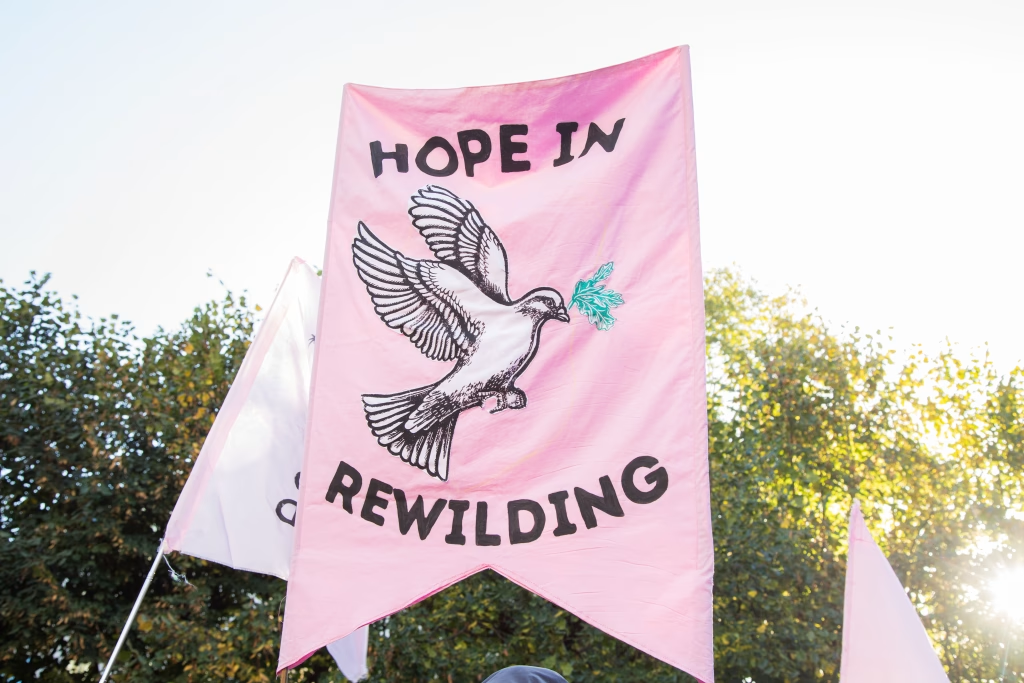
At a time when the UK has committed to protecting 30% of land for nature by 2030 – a key UN target adopted by nearly 200 countries – one question remains: who will deliver it?
The Government’s Land Use Framework released last month makes clear that meeting climate and biodiversity targets will require strategic changes in how land is used, and a national effort to bring nature back and shore up the systems we all depend on, from food production to clean air and rivers, and flood and climate change mitigation.
In a country marked by staggering land inequality, where 50% of land is owned by 1% of the population, the ability and responsibility to protect nature into the future lies predominantly with large landowners. And in England, one of our top 10 landowners – owning over 100,000 acres of rural land in England – is the Church Commissioners, the body responsible for managing the Church’s of England’s largest investment fund.
In recent years, our Rewild the Church campaign has seen growing support for the Commissioners to play a leading role in meeting 30by30. This support has come from both within and beyond the Church of England driven by the Church’s moral and spiritual standing, huge landholding, and considerable financial reserves. More than 130,000 people have signed our petition, over 100 public figures have endorsed calls for action through our 95 Wild Theses and open letter, and the Church’s democratic body, the General Synod, has recently voted for a motion on the Commissioners’ role to be debated.
Across the Church and wider public, many see the Commissioners’ land as a unique opportunity to contribute meaningfully to nature recovery, and as an expression of the Fifth Mark of Mission of the Church – to safeguard the integrity of creation and sustain and renew the life of the earth. And yet, despite this sentiment and momentum, the Church Commissioners is not yet committed to meeting 30by30.
Why did we write Getting Back to the Garden?
Despite the growing movement calling on the Commissioners to act, and widespread recognition that ethical investment and environmental stewardship can align, the investment body has not seized this opportunity with the enthusiasm one might expect. Instead, there have been expressions of concern from the Commissioners as to whether protecting nature may compromise national food security, and the body has suggested that its fiduciary duty – to generate financial returns to support the Church’s mission – may limit the scale and speed of action. The Lead Bishop for Environment, who is also a Church Commissioner, confirmed in 2025 that the Commissioners had not yet assessed the financial cost or benefit that meeting 30by30 on its 100,000+ acres may involve.
Getting Back to the Garden was written to examine whether these perceived tensions are real barriers, and to set out what a credible, financially responsible pathway to 30by30 for the Church Commissioners could look like.
Using the information publicly available in the Commissioners’ reports, we examined what land it owns, the income that may generate, how much of the £11bn fund may need to be invested to meet 30by30, and whether acting — or failing to act — would be more likely to constitute an organisational risk or failure of fiduciary duty.
We were thrilled that some amazing people including Sir Partha Dasgupta, Isabella Tree, Deborah Meaden and Professor Ian Bateman endorsed Getting Back to the Garden, and we hope you find it as useful as they did.
We’ve summarised our key findings below, but you can go ahead and read the full report here.
What did we find?
The more than 100,000 acres of rural English land held within the Church Commissioners’ £11.1bn portfolio is predominantly used for commercial farming. It includes around 5,000 acres of lowland peat – currently emitting significant carbon when farmed – and sizable areas of lower-productivity farmland where the opportunity cost of transition to nature restoration is relatively low. Encouragingly, together with land already managed for nature (around 3.5% of its current rural landholding), these priority areas take the Commissioners close to halfway toward meeting 30by30.
Our paper proposes that, after targeting peat, lower-grade farmland and areas with the highest ecological potential, the Commissioners also transition a minority of marginal agricultural land – supporting farmers who are keen to do so financially and practically through that process. With this approach, there would be no need for the Commissioners to change the land use of any of their non-peatland highly productive farmland.
A central question is cost
Would meeting 30by30 compromise the fund’s sustainability, and its ability to support the Church into the future? First, we looked at the position of the fund: an £11.1bn endowment, with returns averaging 9.6% a year for the previous 3 decades. Its returns far outstrip its spending on supporting the Church; in the last financial year, it made a net profit of over £600m.
Drawing on the Crown Estate’s approach, the paper estimates that supporting tenant farmers to transition to protecting nature on the acreage required to meet 30by30 would require an investment of around £19.5 million. In the context of the Commissioners’ finances, this is strikingly small: just 0.18% of its £11.1 billion portfolio, or 2.9% of the last financial year’s profit. Even if it financed a multi-year scheme in a single year, the Commissioners would still have retained over 97% of its annual surplus.
In other words, a meaningful contribution to 30by30 is not only feasible; at the scale of the fund, it is financially negligible.
This matters because fiduciary duty is often presented as a barrier to environmental action. The assumption is that land must be managed for maximum financial return, and that restoring nature comes at a cost. But this interpretation is increasingly outdated and incomplete.
Fiduciary duty is about long-term stewardship: managing risk, aligning with mission, protecting the future value of assets, and avoiding action that is financially unsustainable.
In the current context, the policy landscape in the UK is shifting. Environmental markets are expanding. Biodiversity loss is now recognised as a material risk to food systems, economic stability and national security. And the reputations of large institutions are susceptible to damage if they are seen not to be fulfilling their national and international social and environmental responsibilities – particularly when they hold an extraordinary level of power, wealth, and resource. Seen in this light, nature recovery is not a constraint on fiduciary duty – it is an expression of it.
Given the Commissioners’ financial capacity, the paper argues that inaction on 30by30 carries financial, regulatory and reputational risk. Equally, decisive action is an opportunity to enhance the long-term resilience and value of the estate, access emerging income streams from carbon, biodiversity and ecosystem services, support tenant farmers in a fair and forward-looking transition, and signal that the Church is willing to act in the long-term interests of the nation.
The Church has faced similar moments before. When it divested from fossil fuels, it showed that ethical leadership and financial performance can go hand in hand. Meeting 30by30 is the next step in that journey.
Getting Back to the Garden sets out a practical, evidence-based pathway for doing so – one that is financially sound, legally robust, and faithful to the Church’s mission.
The opportunity is clear. The resources are available. The mandate – national, financial and moral – is already in place.
The question is no longer whether the Church Commissioners can act. It is whether it will.
Our blog posts are written by our core team and guest bloggers. If you have an idea for a blog post please pitch it to us: info@wildcard.land
CAMPAIGNS
ARCHIVES
- October 2026
- September 2026
- August 2026
- July 2026
- June 2026
- May 2026
- April 2026
- March 2026
- February 2026
- December 2025
- November 2025
- October 2025
- September 2025
- August 2025
- July 2025
- June 2025
- May 2025
- April 2025
- March 2025
- February 2025
- December 2024
- November 2024
- October 2024
- September 2024
- August 2024
- July 2024
- June 2024
- March 2024
- February 2024
- January 2024
- December 2023
- November 2023
- August 2023
- July 2023
- May 2023
- February 2023
- January 2023